
Bolted Joints: Axial Stiffness of Clamped Members
Using photoelastic stress fields, finite-element analysis, and a frustum-based hand calculation to estimate — and compare — the axial stiffness of the clamped members in a preloaded bolted joint.
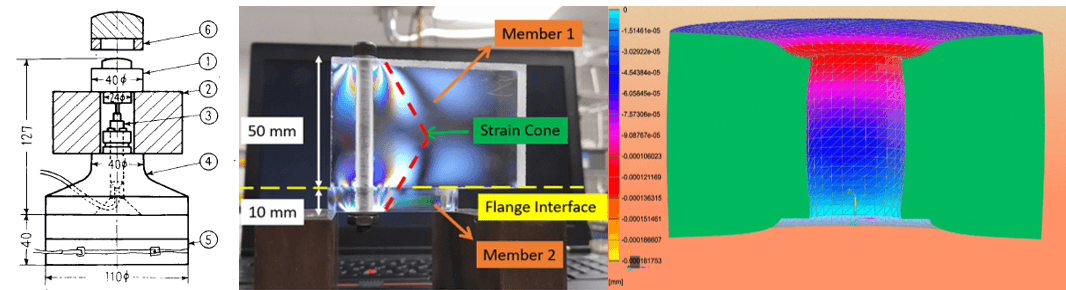
Bolted joints are among the most commonly used structural connection methods. They are widely used because they are easy to assemble and disassemble, can generate very high clamping forces within a small footprint, and are relatively straightforward to design and manufacture.
If we represent a bolted connection using a spring model, it looks like this:
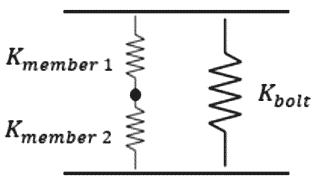
As shown in the spring model, the member stiffness is in parallel with the bolt stiffness. This means that when an external force is applied to a bolted connection, the bolt and the clamped members share the applied load according to their stiffness ratios. A higher member-to-bolt stiffness ratio means a higher percentage of the load is carried by the clamped members. The stiffness of the members also plays a key role in preventing joint separation.
However, predicting the stiffness of bolted members is not easy. This was an important research question during the 1970s through the 1990s. These studies mainly examined how strain zones form below the bolt head, what geometric shapes best approximate these zones, and how stiffness can be calculated from these strain-zone geometries.
This article looks at the stress field formed in a preloaded bolted connection using photoelastic viewing techniques. Using this stress-field geometry, the axial stiffness of the members is calculated and compared with experimental results and FEA.
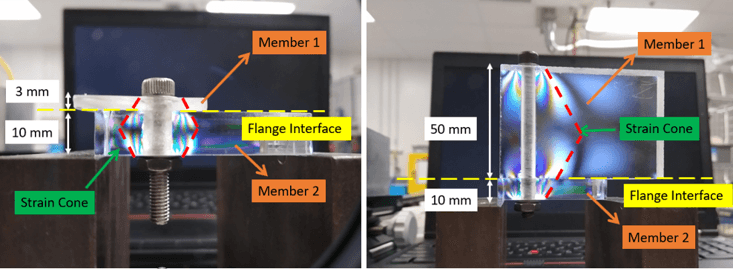
A short note on stress birefringence
We are able to see the stress field in these acrylic member plates because of a property called stress birefringence. When stress is applied to certain clear amorphous solids, the spacing between molecules in the solid changes accordingly.
This causes light polarized in one direction to pass faster or slower than light polarized in another direction. Light in a particular direction can travel more freely if the molecules in that direction are spaced farther apart, and vice versa. In this sense, the application of stress introduces two different refractive indices into the material and makes it birefringent, or double-refracting.
To observe stress birefringence, the material can be placed between two crossed polarizers. If there is no material in the light path, no light should pass through the second polarizer. Introducing a birefringent material between the two polarizers causes light to undergo a phase shift that depends on the difference between the two refractive indices and the thickness of the material. The phase shift alters the polarization of light, which allows some light to pass through the second polarizer.
When white light passes through this stress-induced birefringent material, the individual wavelengths in the white light have different refractive indices. This means that the phase shifts for these individual wavelengths are also different.
If the phase shift for a particular wavelength is 2π, it is essentially equivalent to that wavelength not passing through the material at all. That wavelength will be blocked by the second polarizer and will not be seen. Similarly, if the phase shift is π, that wavelength will pass through the second polarizer without obstruction and will be visible to the eye. The different colors seen in the stress field are therefore different wavelengths of visible light expressed based on the amount of phase shift while passing through the birefringent material.
In the future, it would be useful to predict the stress level in a component by looking at the fringe patterns.
Back to bolted connections
Experiment
To close the loop on member stiffness in bolted connections, we start with experimental data. Measuring member stiffness experimentally is not easy, so this analysis relies on data from previous research papers. Maruyama [1] used a simple experimental setup to determine the axial stiffness of the members. The setup consisted of a circular plate with a hole and two pressure pieces, simulating a bolt head and nut, to apply the axial load.
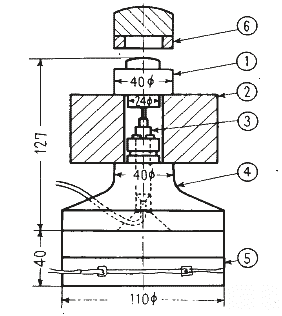
The diameter of the hole was 25 mm, and the diameter of the circular plate was 100 mm. The material of the circular plate was S45C, which is part of the Japanese steel grading system. Its American equivalent is AISI 1045, with E = 200 GPa.
Here, a single circular plate is used as a replacement for the two clamped members found in a bolted connection. The experimental stiffness of this member was reported to be 565 kgf/µm, or 5540 N/µm.
FEA
The same circular-plate and pressure-plate geometry used by Maruyama was simulated in an FEA package. The faces of the circular plate were subdivided at the pressure-plate interface locations. The bottom pressure-plate interface was fixed, and the top pressure-plate interface was given a fixed constraint in X and Y, while Z was kept free.
The X-Y constraint on the top is important because the model assumes there is no slip between the circular plate and the pressure plates. If the X-Y constraint on the top is omitted, the stiffness will come out artificially lower. This is one of the challenges with FEA: it will always give an answer, regardless of whether the model, mesh, loads, and boundary conditions are correct. It is tempting to believe that whatever the FEA predicts is true.
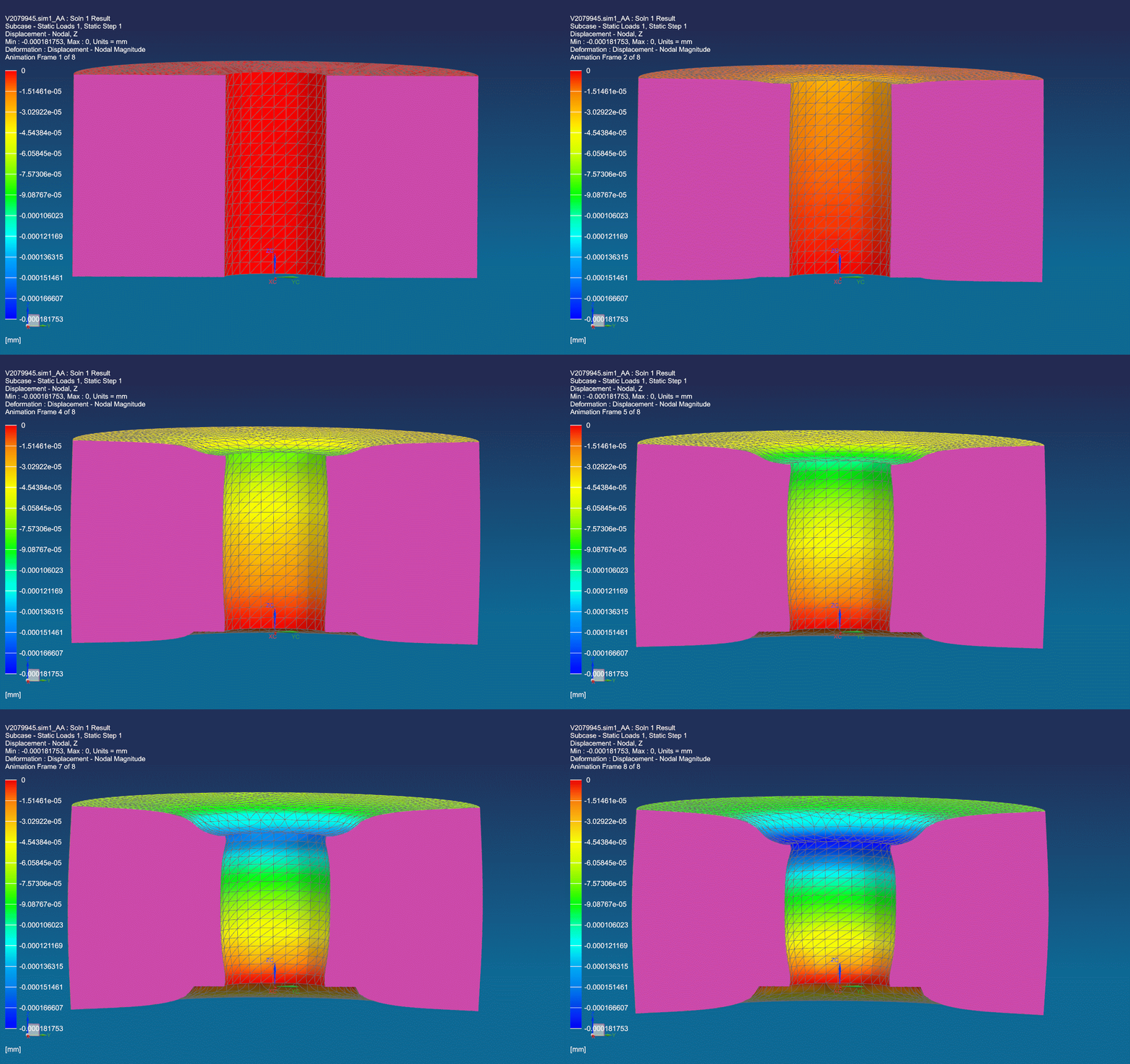
Based on the FEA, the stiffness of the clamped plate is 1000 N / 0.18 µm = 5555 N/µm, which is very close to Maruyama's experimental result of 5540 N/µm.
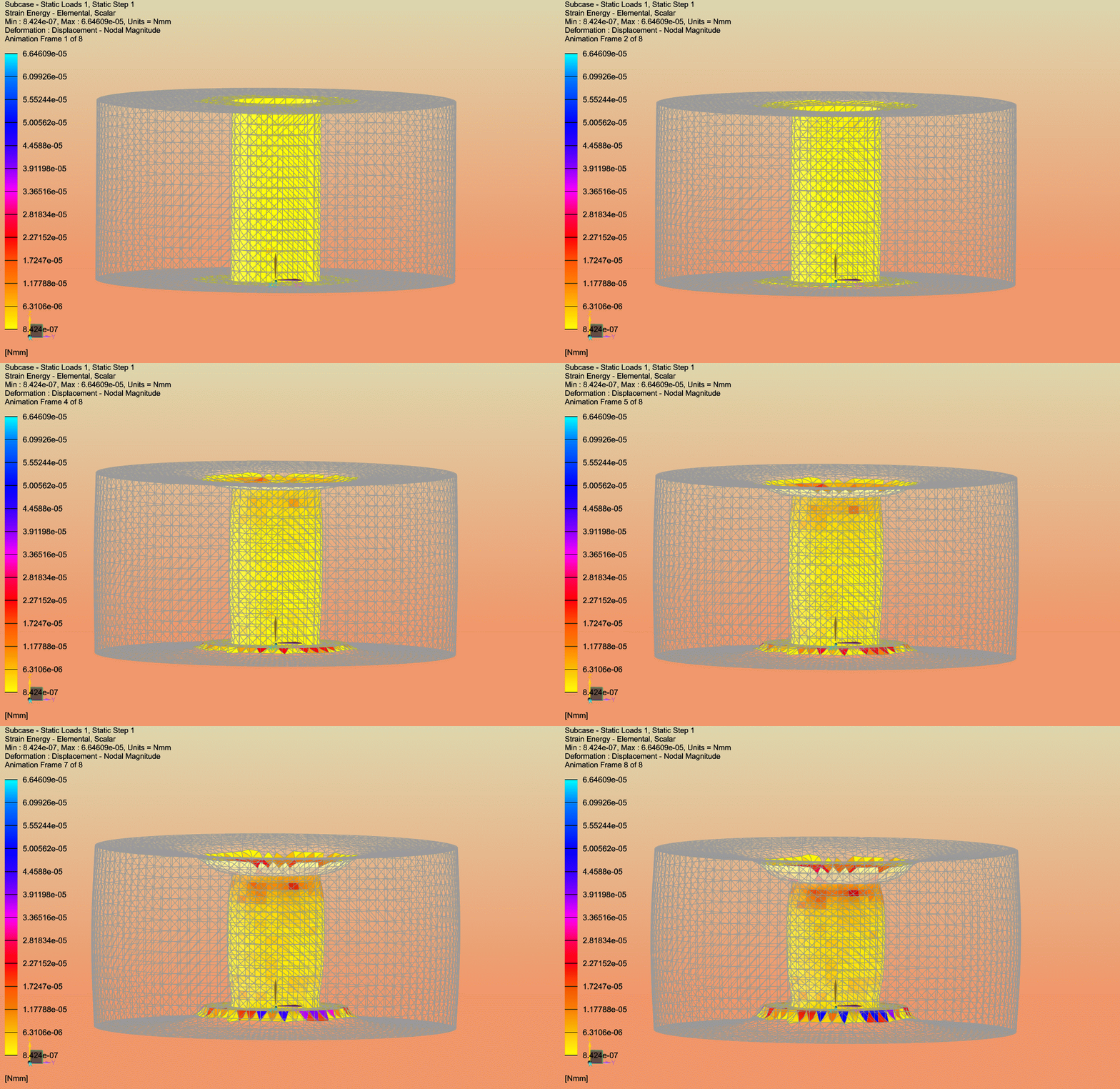
The strain-energy plot shows that most of the strain energy is stored either just under the bolt head or just above the nut. This is consistent with the photoelastic experiments, where many colored fringes appear specifically at those locations.
Theory
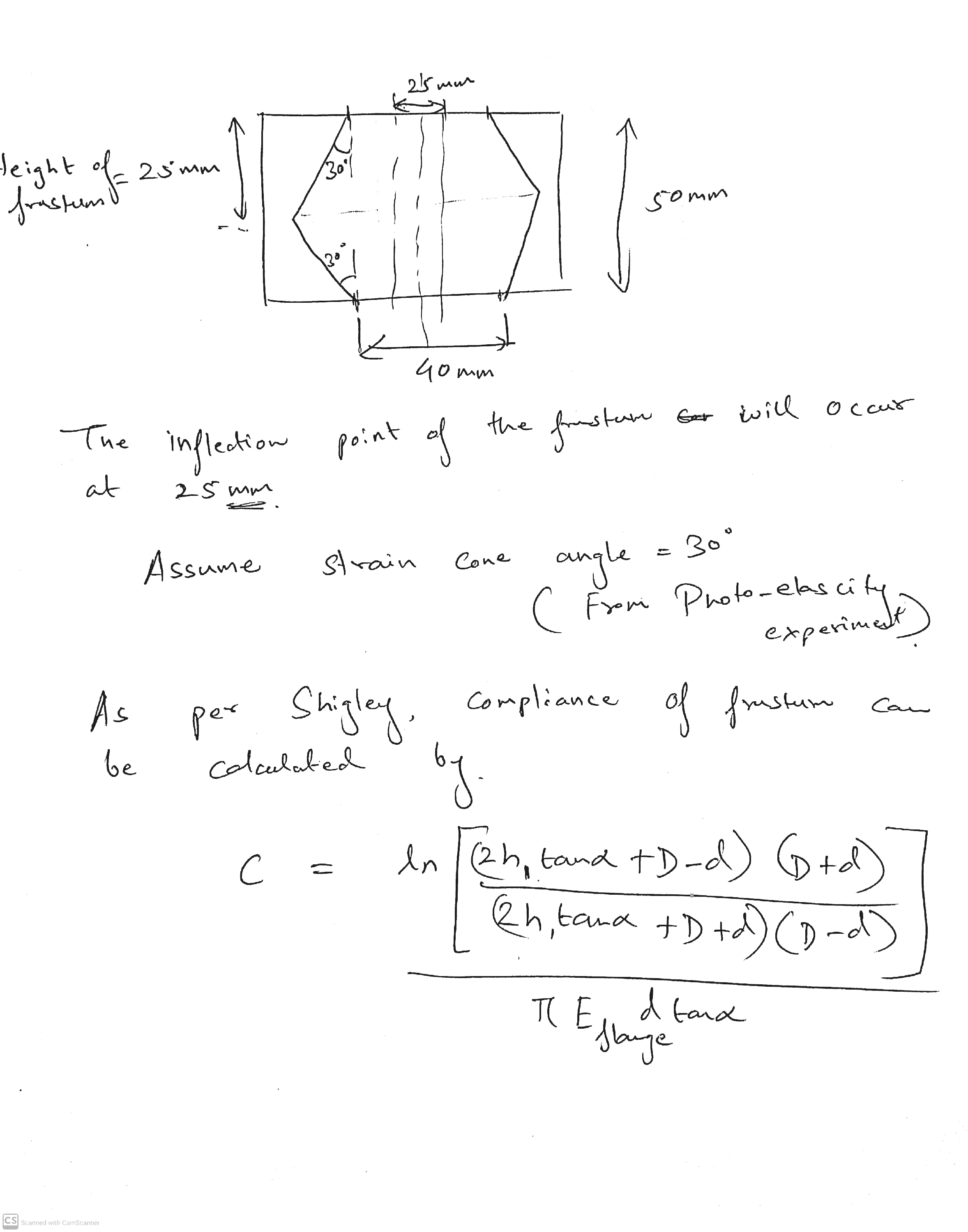
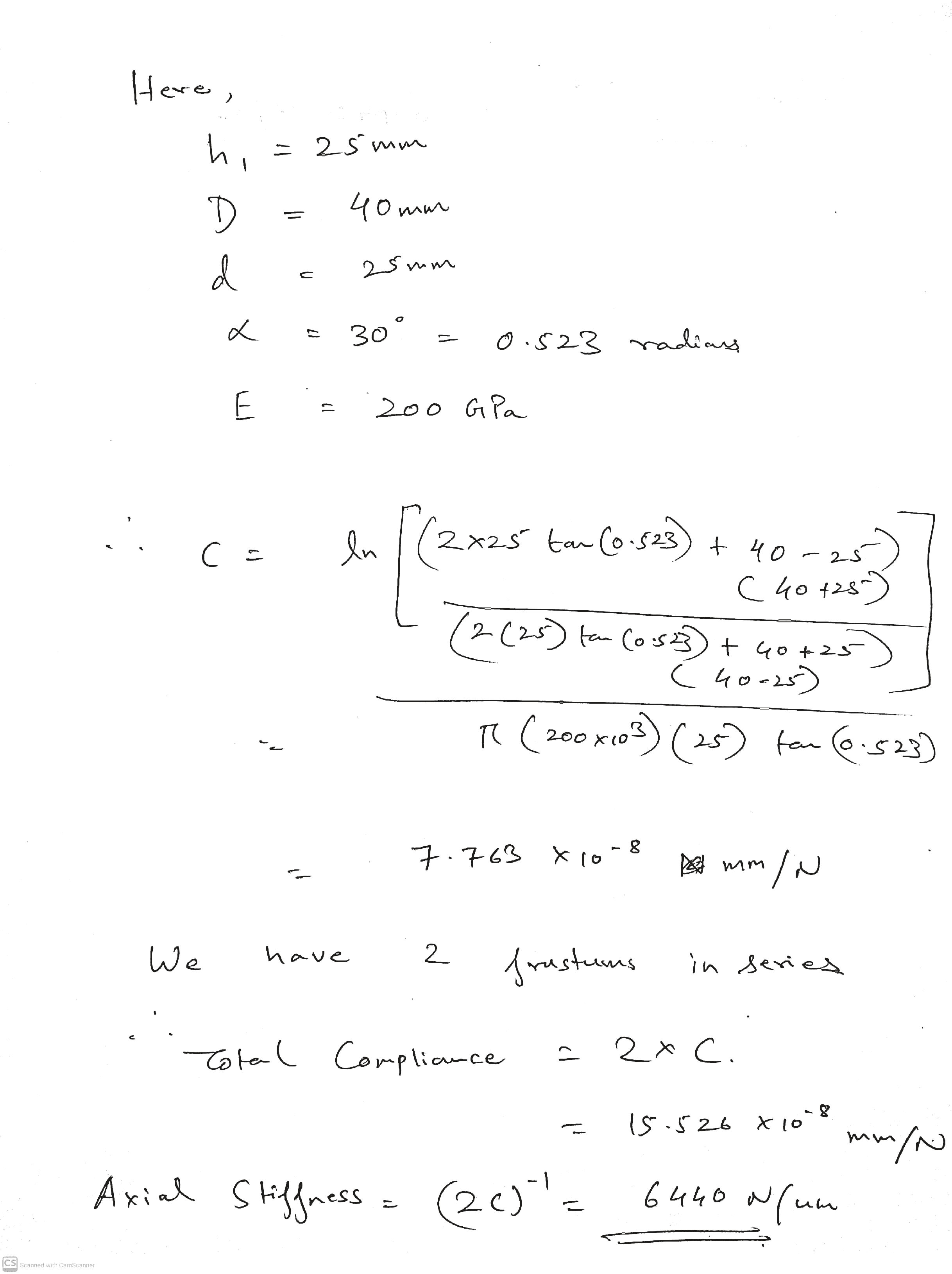
The theoretical calculations for the axial stiffness of the bolted members are shown below. The theory predicts a stiffness of 6440 N/µm.
Comparison
Experimental
5540 N/µm
FEA
5555 N/µm
Theory
6440 N/µm
From the comparison between the experimental, FEA, and theoretical values, it is clear that the current analytical model overpredicts the axial stiffness of the clamped members by about 16%. The experimental and FEA values are almost an exact match, which is encouraging.
The theory most likely overpredicts stiffness because of the approximation used for the shape of the strain zone. The shape was assumed to be a frustum with a 30° cone angle, which is generally recommended by textbooks. In reality, as seen from the photoelastic experiments, the strain-zone shape is slightly curved at the inflection points.
As a side note, the theory does not account for Saint-Venant's principle. The impact of a local force field on an object extends only up to 3-5 times the characteristic dimension, which in this case may be the bolt-head diameter. Beyond that limit, the material should not feel any impact.
References
- [1] Kazuo Maruyama, Isamu Yoshimoto, and Yoshiyuki Nakano, “On Spring Constant of Connected Parts in Bolted Joints,” Bulletin of JSME, Vol. 18, No. 126, December 1975.